
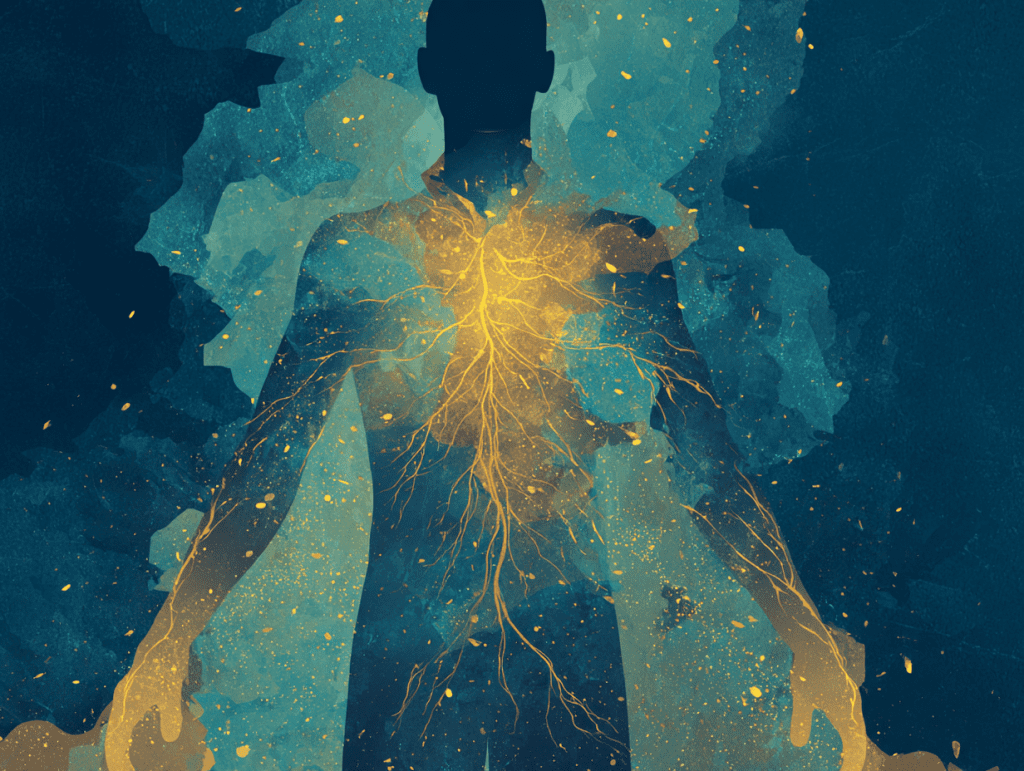
Somatic integration after a psychedelic experience refers to the process of using body-based practices to help your nervous system process, stabilize, and anchor what surfaced during the experience. Insights from a psychedelic journey do not always translate into lasting change through reflection alone. The body plays a central, often underestimated role in that process, and working with it intentionally, ideally with professional support, is what allows the experience to become genuinely useful.
Why the Body Gets Involved in the First Place
Psychedelics do not work only on thought. They shift how the brain processes sensory input, emotion, memory, and bodily awareness all at once. Research published in Frontiers in Psychology shows that psilocybin, for instance, modulates connectivity between the amygdala and frontal cortical regions involved in emotional regulation, with some of these changes persisting for weeks after the session. That is not just a cognitive shift. It is a whole-system event.
During a session, many people report heightened awareness of physical sensations: tension in the chest, warmth in the limbs, tightness in the throat, or the sudden release of something held for years. These are not incidental details. They are often where the most meaningful material lives. If that material is only processed intellectually afterward, through journaling or talk therapy, the body can remain stuck in a holding pattern it does not know how to exit on its own.
This is the core argument for body-based psychedelic integration. Somatic approaches meet the experience where it actually happened, not just where you can put words to it.
What Somatic Integration Actually Means
Somatic integration after a psychedelic experience is not a single technique or modality. It is an orientation toward healing that treats the body as a primary site of processing rather than a secondary one. It draws on a range of established practices including Somatic Experiencing, EMDR, breathwork, mindful movement, and body scanning, each of which helps individuals develop awareness of physical sensations and gradually release what the nervous system has been holding.
A 2022 concept analysis published in Frontiers in Psychology by Bathje, Majeski, and Kudowor reviewed 24 existing definitions of psychedelic integration and found that somatic approaches were a consistent thread across models. The study’s synthesized definition describes integration as a process of actively engaging with psychedelic content to incorporate insights into daily life, toward greater balance across mind, body, and environment. Body-based practices are not a supplement to that process; in many frameworks, they are the process.
Integration practitioners often pair talk-based work with body-based approaches, because many of the symptoms people seek to address, including anxiety, depression, and trauma responses, do not resolve simply through gaining cognitive insight. Understanding why something happens is not the same as changing the nervous system’s conditioned response to it.
What Gets Processed Through the Body
To understand why somatic integration matters for people working with psilocybin or other psychedelics, it helps to understand what the body actually stores. Trauma research, particularly the work developed through Somatic Experiencing by Peter Levine, has established that unresolved stress and trauma are held in the body as physiological patterns: altered muscle tone, shifts in breathing, changes in posture, and a nervous system tuned toward threat. These patterns can surface during a psychedelic experience with unusual intensity, sometimes for the first time.
When they do, the window of opportunity is significant. The nervous system has been temporarily reorganized. Habitual defenses are more permeable. What was previously inaccessible can become reachable. But that window does not stay open indefinitely, and without support, a person may return to their baseline patterning before the material has been given a chance to resolve. This is one reason why what happens in the days and weeks after a session often matters as much as the session itself.
Body-based psychedelic integration provides specific tools for working within that window: grounding practices to regulate the nervous system, gentle movement to process held physical tension, breathwork to modulate arousal, and somatic awareness exercises that help people stay with difficult sensations rather than reflexively avoiding them. These are not passive activities. Done with intention and guidance, they are the mechanism through which insight becomes change.
Practical Somatic Practices Worth Knowing
There is no universal protocol for somatic integration after psilocybin or other psychedelic experiences, and that is appropriate, because each person’s experience is different. That said, several practices appear consistently across frameworks and can be meaningfully incorporated into a guided integration plan.
Body scanning involves moving attention slowly through the body to notice areas of tension, warmth, numbness, or movement without trying to interpret or change them. It builds the capacity to tolerate sensation, which is a foundational skill for any deeper somatic work.
Breathwork is one of the most direct ways to influence nervous system state. Extended exhale breathing, where the exhale is longer than the inhale, activates the parasympathetic system and helps regulate heightened arousal that may persist after a session. This is not the same as intensive breathwork experiences; it is a regulation tool used daily or in moments of activation.
Mindful movement, including slow walking, gentle yoga, or simply shaking and stretching with awareness, helps the body discharge what has been activated without suppressing it. The emphasis is on attending to what arises rather than performing a specific form correctly.
Somatic journaling pairs body awareness with reflective writing. Rather than beginning with thoughts about the experience, a person first notices what is present in the body, describes those sensations in concrete terms, and then follows where that leads. This bridges the somatic and cognitive dimensions of integration without privileging one over the other.
EMDR is an evidence-based clinical modality that has been used in psychedelic integration contexts. It uses bilateral stimulation (through eye movements, tapping, or audio) to help the brain process and desensitize traumatic memory, and there is growing interest in its use with people doing psychedelic-assisted work for PTSD and trauma histories.
The Timing and Structure of Somatic Integration
The integration period is generally understood to begin immediately after a session and to extend for weeks or months, depending on the depth of the experience and the individual. In the first 48 to 72 hours, the priority is usually stabilization rather than interpretation. The nervous system needs to return to a baseline that feels safe, and gentle somatic practices support that process more effectively than intensive analysis or attempting to extract meaning from everything that arose.
In the weeks that follow, more structured somatic work becomes appropriate. This is where working with a professional guide who understands the relationship between psychedelic states and body-based healing becomes especially valuable. An experienced guide can help a person identify which sensations or patterns are asking for attention, distinguish between productive discomfort and activation that requires regulation, and suggest practices calibrated to their specific history and current capacity.
Without that guidance, people sometimes either bypass somatic material entirely, focusing only on the narrative or the insights, or become overwhelmed by physical sensations they do not know how to work with. Both outcomes leave something significant on the table.
When Somatic Integration Is Especially Relevant
Somatic integration after a psychedelic experience is relevant for most people doing this work, but it is particularly worth prioritizing for those with a history of trauma, chronic stress, or body-focused symptoms like chronic pain, tension disorders, or somatic anxiety. These are presentations where the body is already communicating something that has not been fully processed, and psychedelic experiences often amplify that communication rather than resolve it on their own.
People with prior experience in somatic therapy, yoga, breathwork, or mindfulness practices often find that psychedelic work integrates more smoothly because they already have a framework for attending to physical experience. If that background is present, a good integration guide can build on it directly. If it is not, somatic integration may require first developing some basic body awareness capacity, which is itself a valuable outcome and a foundation for longer-term wellbeing.
Why Professional Support Changes the Outcome
Somatic integration psychedelics work is not something that requires a therapist for every step. There is a legitimate role for self-directed practice. But the quality of support available during the integration period consistently shows up as a meaningful variable in how well experiences are absorbed and applied over time.
A professionally supported integration process offers several things that self-directed work does not: a structured container for working with difficult material, a trained observer who can track somatic cues that the individual may not notice in themselves, and continuity of care that extends the value of a single experience into lasting behavioral and psychological change. At JourneyŌM, this is what concierge guidance is designed to provide: not just a check-in after the fact, but a coherent process that treats the body as a full participant in your healing.
If you are preparing for or moving through the integration period after a psychedelic experience and want professional support, here are the best next steps:
- Is This Right for Me? — Self-Evaluation — A confidential self-assessment to help you understand your readiness and whether a guided experience is a fit. The right starting point if you’re still exploring.
- Start with a Conversation — A complimentary 15-minute call with the JourneyŌM team. No pressure, just clarity on where you are and what’s possible.
- Concierge Consultation — A full intake session for seekers ready to move forward. We listen, assess fit, and only proceed to matching if it’s right for both sides. See pricing
Sources
- Bathje GJ, Majeski E, Kudowor M. (2022). Psychedelic integration: An analysis of the concept and its practice. Frontiers in Psychology, 13:824077. https://doi.org/10.3389/fpsyg.2022.824077
- Metastasio A, et al. (2025). The phenomenology of psilocybin: transformative insights for research and clinical practice. Frontiers in Psychology. https://www.ncbi.nlm.nih.gov/pmc/articles/PMC12061882/
- Brom D, Stokar Y, Lawi C, et al. (2017). Somatic Experiencing for posttraumatic stress disorder: A randomized controlled outcome study. Journal of Traumatic Stress, 30(3), 304–312. https://doi.org/10.1002/jts.22189
- American Psychological Association. Eye Movement Desensitization and Reprocessing (EMDR) Therapy. Clinical Practice Guideline for the Treatment of PTSD. https://www.apa.org/ptsd-guideline/treatments/eye-movement-reprocessing