
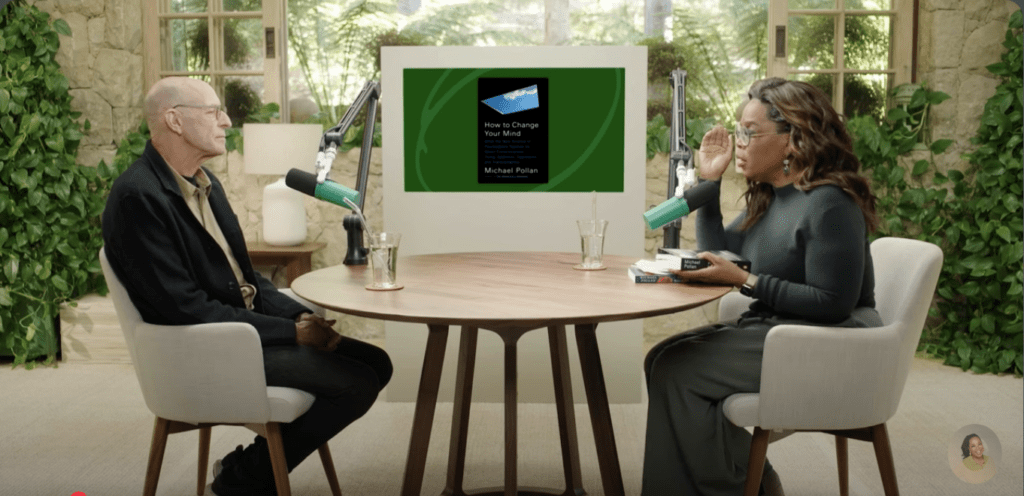
A Conversation That Reflects a Broader Shift
In March 2025, Oprah Winfrey sat down with author Michael Pollan for a wide-ranging conversation about psychedelics, therapy, and the possibility of lasting change. The exchange drew significant attention, and for good reason: it brought nuanced, research-grounded thinking to a mainstream audience that is increasingly curious but often unsure where to start.
Pollan’s work, particularly his book How to Change Your Mind, has done more to reshape public understanding of psychedelics than almost anything else in recent years. His central argument is not that these substances are panaceas. It is that, under the right conditions and with the right support, they hold genuine therapeutic potential for a range of mental health challenges, including depression, PTSD, OCD, and end-of-life anxiety.
That framing matters. The psychedelic therapy landscape is not one of easy answers or guaranteed outcomes. It is one of careful conditions, genuine risk, and real possibility.
What “Set and Setting” Actually Means in Practice
One concept came up repeatedly in the Oprah and Pollan conversation: set and setting. The term originates with psychedelic researcher Timothy Leary, but it has since been validated across decades of clinical work. “Set” refers to mindset, including intentions, psychological history, and emotional readiness. “Setting” refers to the physical and relational environment in which the experience takes place.
These are not abstract ideas. They have direct, measurable effects on outcomes. Research from institutions like Johns Hopkins and NYU has consistently shown that the quality of therapeutic support and the safety of the environment are among the strongest predictors of whether a psychedelic experience produces lasting benefit or lasting distress.
For someone navigating the psychedelic therapy landscape without support, this creates a real problem. A substance alone does not provide set and setting. A guide does.
Why Professional Guidance Is Not Optional
There is a version of this conversation that treats guides as a nice-to-have addition to a psychedelic experience. That version gets it wrong. Professional guidance is not supplementary. It is structural.
A trained guide does several things that cannot be replicated by reading an article or watching a documentary. They conduct thorough screening to assess whether an experience is appropriate given your history, medications, and current mental state. They help you clarify your intentions and prepare psychologically in the weeks before. They are present during the experience itself, providing a stable, grounded presence if difficulty arises. And they support integration afterward, helping you make sense of what emerged and carry it meaningfully into daily life.
Understanding how psychedelic guides are vetted makes it easier to judge whether someone can actually do all of that.
Each of these elements matters independently. Together, they form a continuity of care that is qualitatively different from going it alone or relying on informal social networks.
This is not about gatekeeping. It is about the honest reality that psychedelic experiences can be profoundly disorienting, and that disorientation handled well is often where the growth happens. Disorientation handled poorly can reinforce existing trauma or create new distress. The difference is frequently the quality of support around the experience.
The Role of Integration
One of the most important points Pollan has made across his writing and conversations is that the psychedelic experience is not the endpoint. It is the beginning of a process. What happens in the days, weeks, and months after a session is where the potential for sustained change is either realized or lost.
Integration is the work of making meaning from the experience and translating insight into behavior. This can take many forms: structured conversations with a guide, journaling, changes to daily habits, or simply time and reflection. What it requires, consistently, is ongoing support from someone who understands what you went through and can help you work with it rather than around it.
Without integration, many people find that the clarity they felt during an experience fades quickly, leaving only a vague sense that something important happened. With it, the insights from a session can genuinely reshape how someone relates to their anxiety, their relationships, or their sense of self.
Personal Stories and the Limits of What They Can Teach
One of the things the Oprah and Pollan conversation did well was center personal narratives: stories of people who found relief from PTSD, who processed grief, who moved through long-standing depression after exhausting conventional options. These stories are real and they are worth hearing.
They also have limits. A personal story describes what happened for one person under specific conditions that may or may not resemble yours. It cannot tell you whether a psychedelic experience is appropriate for you, what preparation would look like given your history, or what a difficult moment in a session would feel like and how to navigate it.
This is not a criticism of personal narratives. It is a reason to take them seriously while also seeking individualized guidance rather than trying to replicate someone else’s experience in a vacuum.
What Responsible Access Looks Like
The psychedelic therapy landscape is still evolving. Legal frameworks vary significantly by jurisdiction, and the range of practitioners, facilitators, and programs available spans an enormous spectrum of quality and approach. This makes vetting essential.
At JourneyŌM, we work specifically to close the gap between growing public interest and access to genuinely qualified guides. Our process includes thorough screening on both sides: we assess seekers to understand their history and intentions, and we vet guides based on training, experience, and approach. The goal is not to place people as quickly as possible. It is to make intentional matches that support safe, meaningful experiences.
We also recognize that readiness is not binary. Some people who reach out to us are ready to move forward with a supported experience. Others need more time in preparation, or would benefit from working with a therapist first. We say so honestly when that is the case, because safety takes priority over any other consideration.
Screening and Informed Consent Are Not Formalities
One point the Pollan and Oprah conversation raised that deserves more attention: screening and informed consent are functional, not ceremonial. In a well-run guided experience, the intake process is where a trained guide learns whether you have contraindicated medications, a personal or family history of psychosis, or unresolved trauma that needs additional support before you consider an altered-state experience. These are not checkbox exercises. They are how a guide determines what, if anything, is appropriate for you at this moment.
Informed consent is equally substantive. It means understanding, in real terms, what the experience might involve: the range of possible emotional responses, the duration, what difficulty can look like and how it is handled, and what integration support will follow. Someone who enters a session without that understanding is far more likely to be destabilized by what arises, even if the experience itself is within a normal range.
A Field That Demands Honesty
The growing visibility of psychedelic therapy in mainstream culture is, on balance, a good thing. More people are asking serious questions, and more clinicians and researchers are working to answer them carefully. At the same time, visibility brings hype, and hype is one of the things this field can least afford.
Psychedelics are not miracle cures. They are powerful tools that can be used well or poorly. The difference comes down to preparation, support, and integration: the elements that constitute real guidance. The conversation between Oprah and Michael Pollan is valuable precisely because it holds both the promise and the responsibility in view at the same time. That is the frame we work from at JourneyŌM.
If you are curious about your own readiness, or want to understand what a guided experience would actually involve, we are here to help you think it through honestly.
Ready to explore what guided support could look like for you?
- Is This Right for Me? — Self-Evaluation — A confidential self-assessment to help you understand your readiness and whether a guided experience is a fit. The right starting point if you’re still exploring.
- Start with a Conversation — A complimentary 15-minute call with the JourneyŌM team. No pressure, just clarity on where you are and what’s possible.
- Concierge Consultation — A full intake session for seekers ready to move forward. We listen, assess fit, and only proceed to matching if it’s right for both sides. See pricing
Sources
- Johns Hopkins Center for Psychedelic and Consciousness Research
- NYU Langone Health Psychedelic Medicine Program
- Michael Pollan, How to Change Your Mind (2018)
- MAPS (Multidisciplinary Association for Psychedelic Studies) – Clinical Research
- Carhart-Harris et al., “Trial of Psilocybin versus Escitalopram for Depression,” NEJM (2021)