
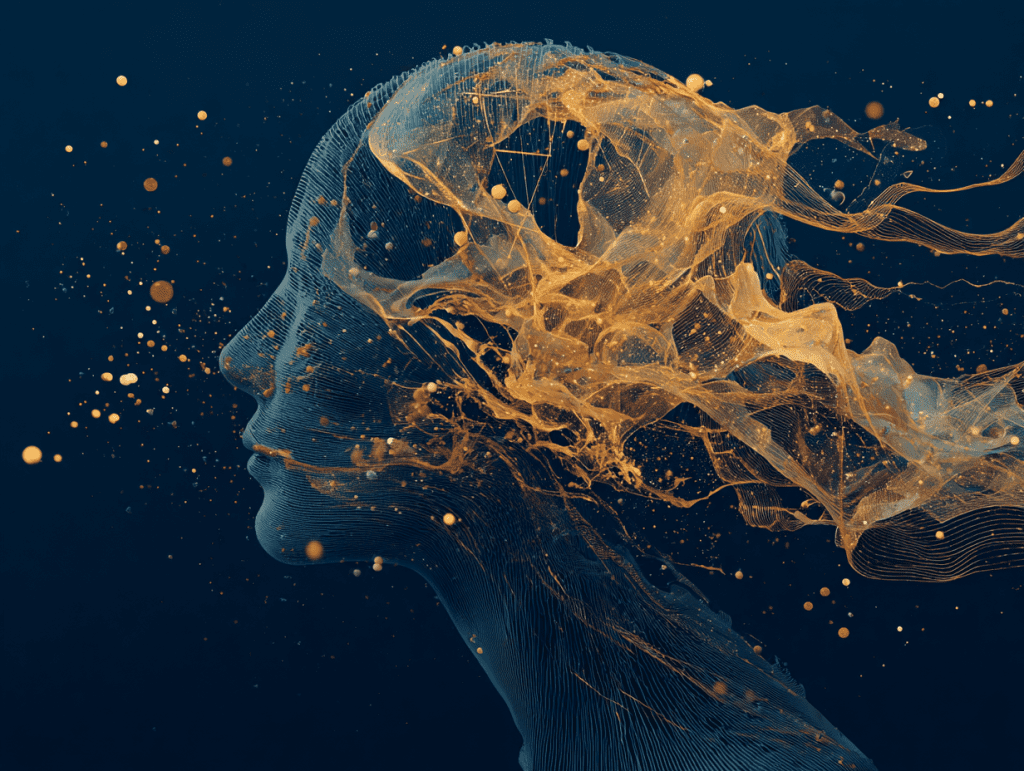
The default mode network is a cluster of brain regions responsible for self-referential thinking, rumination, and your ongoing sense of “I.” Research on default mode network psychedelics shows that psilocybin temporarily disrupts this network’s rigid activity, allowing the brain to form new connections and break out of entrenched mental patterns. This is one of the leading neurological explanations for why psychedelic experiences can produce lasting psychological change.
If you have ever wondered why a single psychedelic experience can shift something that years of conventional therapy could not, the answer may lie in a brain network you have probably never thought about. It is called the default mode network, and understanding what it does, and what happens when psilocybin interrupts it, is one of the more important developments in modern neuroscience.
This is not fringe science. The research comes from institutions including Imperial College London, Washington University in St. Louis, and Johns Hopkins, and it has been published in journals like PNAS, Nature, and Cell. The findings are early in places and incomplete in others. But the picture they are building is coherent, and it matters for anyone seriously considering a psychedelic journey.
What Is the Default Mode Network?
Your brain is not idle when you are doing nothing. When you are not focused on a specific task, a distributed set of regions switches on: the medial prefrontal cortex, the posterior cingulate cortex, the precuneus, and parts of the parietal lobe. Together, these form the default mode network (DMN).
The DMN is active when you daydream, replay past conversations, plan for the future, imagine how others see you, or get caught in a loop of self-critical thought. It is, in a real sense, the network of the self. It constructs and maintains your autobiographical identity, narrating who you are and what your life means. That function is valuable. But it can also become a liability.
In people with depression, anxiety, PTSD, and addiction, the DMN tends to be overactive and unusually rigid in its connectivity patterns. The same neural loops fire again and again. Rumination becomes the default. The same painful stories, the same self-limiting beliefs, play on repeat because the brain has, over time, carved those grooves deep. Research has consistently shown that dysregulation of DMN activity correlates with the kind of ruminative thinking that defines these conditions.
What Psilocybin Does to the Default Mode Network
In 2012, a landmark study led by Robin Carhart-Harris at Imperial College London used fMRI to observe what psilocybin does to brain activity in real time. The findings were striking. Psilocybin significantly reduced coordinated activity within the DMN, and this reduction correlated directly with participants’ subjective experiences of ego dissolution, the temporary sense that the boundaries of the self had dissolved. The more the DMN quieted, the more the sense of a rigid, separate self loosened.
This was not a subtle finding. The disruption to DMN connectivity under psilocybin was, in subsequent research from Washington University, more than three times greater than the disruption produced by methylphenidate (Ritalin) at a comparable dose. Psilocybin, in other words, produces changes in functional connectivity that are categorically different in magnitude from other psychoactive substances.
Crucially, the disruption is not simply the DMN going offline. What neuroimaging studies consistently show is that psilocybin reduces the rigid, insular connectivity within the DMN while simultaneously increasing communication between the DMN and other brain networks that are normally kept at a distance. Networks that process sensation, attention, and executive function begin to talk to each other in ways they typically do not. The brain, temporarily, becomes far more integrated and less compartmentalized.
This is why the experience often feels like seeing everything at once, or like the barriers between thoughts, memories, and perceptions have thinned. It is not a malfunction. It is the network’s usual filtering and sorting system being stepped aside.
The Hippocampus Connection and Why It Matters
One of the more significant findings in recent research involves the relationship between the DMN and the anterior hippocampus. A 2024 study from Washington University found that a single high dose of psilocybin produced persistent decreases in functional connectivity between the anterior hippocampus and the DMN, and these changes lasted for weeks after the experience. The hippocampus plays a central role in memory consolidation and, critically, in fear conditioning. Its decoupling from the DMN may help explain why psychedelic experiences can interrupt deeply conditioned responses: the trauma response, the addiction trigger, the automatic thought pattern.
This is not permanent structural damage. The connectivity changes normalize over time, with most returning to baseline within six months in that same study. But the window of altered connectivity appears to be the period during which psychological integration work is most effective. The brain is, briefly, more plastic. More receptive. Old habits have less gravitational pull.
Neuroplasticity Psychedelics Research: What Is Actually Growing
The disruption of the default mode network is the acute effect, what happens during and immediately after the experience. The longer-term changes involve a different mechanism: neuroplasticity.
Neuroplasticity refers to the brain’s ability to form new connections, grow new dendritic spines (the small protrusions on neurons that receive signals), and remodel its existing architecture. Chronic stress, depression, and trauma are associated with the opposite: synaptic atrophy, reduced dendritic complexity, and loss of spine density in the prefrontal cortex and hippocampus.
Research on neuroplasticity and psychedelics shows that psilocybin reverses this process. A 2021 study published in Nature Neuroscience, using in vivo two-photon microscopy in mice, found that psilocybin induced rapid growth in dendritic spine density and size in the medial frontal cortex, with those changes persisting for at least one month. A 2024 study in Cell confirmed that a single dose produces structural remodeling of dendritic spines in the medial frontal cortex. A comprehensive 2025 review published in Frontiers in Systems Neuroscience found that psilocybin increases expression of plasticity-related genes including BDNF (brain-derived neurotrophic factor) and mTOR in the prefrontal cortex and hippocampus, effects detectable a week after the dose.
BDNF is sometimes described as fertilizer for the brain. It supports the growth and maintenance of neurons, promotes synaptic strengthening, and is associated with resilience to stress. Conventional antidepressants also influence BDNF, but typically over weeks. Psilocybin appears to trigger similar or greater changes far more rapidly.
It is worth being clear about what this research does and does not show. The majority of neuroplasticity studies have been conducted in animal models. Direct evidence in humans is more limited, and we do not yet fully understand which of these cellular changes correspond to which therapeutic outcomes, or how individual variability in response affects the picture. The mechanisms are plausible and the preclinical evidence is strong. The human evidence is growing, but it is not complete.
Why the Experience Itself Is Not Incidental
One point that neuroscience is beginning to clarify is that the subjective experience is not a side effect of psilocybin’s therapeutic mechanism. It appears to be integral to it.
The Washington University research found that performing a perceptual grounding task during the psilocybin experience actually reduced the magnitude of functional connectivity changes in the brain. In other words, redirecting attention toward the external environment during the experience modulated its neurological impact. This suggests that the inner landscape of the journey, what you attend to, how you process what arises, and the mental and emotional engagement with the experience itself, interacts directly with the neural changes underway.
This is why set, setting, and professional support are not optional considerations in psychedelic work. They are variables that shape the neuroscience. A carefully prepared, well-supported experience with skilled integration afterward is a different neurological event than an unsupported one. The brain’s window of plasticity is opened by the compound. What is written in that window depends heavily on context.
What This Means If You Are Considering a Journey
Understanding how psilocybin works on the brain does not make the decision to pursue a guided psychedelic experience simple. The research gives a clearer picture of the mechanism, but it does not remove the need for careful preparation, personal readiness assessment, and experienced guidance throughout the process. It also does not tell you how long the effects last. Our review of psilocybin long term effects covers what the follow-up data shows months and years after a session.
The default mode network will quiet. The brain will become temporarily more integrated. New connections will form. Whether that translates into lasting therapeutic benefit depends on far more than the compound itself, including your history, your intentions, the quality of support you receive, and the work you do in integration afterward. Neuroscience describes the window. Guidance and preparation determine what you do with it.
At JourneyŌM, we work with individuals to assess readiness, match them with vetted professional guides, and support the full arc of the process: preparation, the experience, and integration. If you are curious about whether this path makes sense for you, the best first step is an honest conversation.
- Is This Right for Me? — Self-Evaluation — A confidential self-assessment to help you understand your readiness and whether a guided experience is a fit. The right starting point if you’re still exploring.
- Start with a Conversation — A complimentary 15-minute call with the JourneyŌM team. No pressure, just clarity on where you are and what’s possible.
- Concierge Consultation — A full intake session for seekers ready to move forward. We listen, assess fit, and only proceed to matching if it’s right for both sides. See pricing
Sources
1. Carhart-Harris, R. L., Erritzoe, D., Williams, T., et al. (2012). Neural correlates of the psychedelic state as determined by fMRI studies with psilocybin. Proceedings of the National Academy of Sciences, 109(6), 2138-2143. https://doi.org/10.1073/pnas.1119598109
2. Siegel, J. S., Subramanian, S., Perry, D., et al. (2024). Psilocybin desynchronizes the human brain. Nature. https://www.ncbi.nlm.nih.gov/pmc/articles/PMC10493007/
3. Liao, C., et al. (2025). Psilocybin triggers an activity-dependent rewiring of large-scale cortical networks. Cell. https://doi.org/10.1016/j.cell.2025.11.009
4. Gattuso, J. J., et al. (2023). Default Mode Network Modulation by Psychedelics: A Systematic Review. International Journal of Neuropsychopharmacology. https://doi.org/10.1093/ijnp/pyac074
5. Zhao, X., Du, Y., Yao, Y., et al. (2024). Psilocybin promotes neuroplasticity and induces rapid and sustained antidepressant-like effects in mice. Journal of Psychopharmacology. https://doi.org/10.1177/02698811241249436